Kuotify
Designed.
SaaS
Ux Designer
Ux Designer
SaaS
4 months
4 Months
Ux Designer
4 Months
Figma, Bubble.Io
Figma, Bubbl.io
Figma, Bubbl.io
Overview
The summer after my first year, I was determined to start a business. I explored everything from AI chatbots to voice agents, but nothing clicked until I discovered the SaaS model. I noticed that the trades industry was often overlooked when it came to tech, most tools were too complex or outdated. I saw an opportunity to build a quoting tool specifically for contractors that cared about speed and simplicity over cluttered features.
The summer after my first year, I was determined to start a business. I explored everything from AI chatbots to voice agents, but nothing clicked until I discovered the SaaS model. I noticed that the trades industry was often overlooked when it came to tech, most tools were too complex or outdated. I saw an opportunity to build a quoting tool specifically for contractors that cared about speed and simplicity over cluttered features.
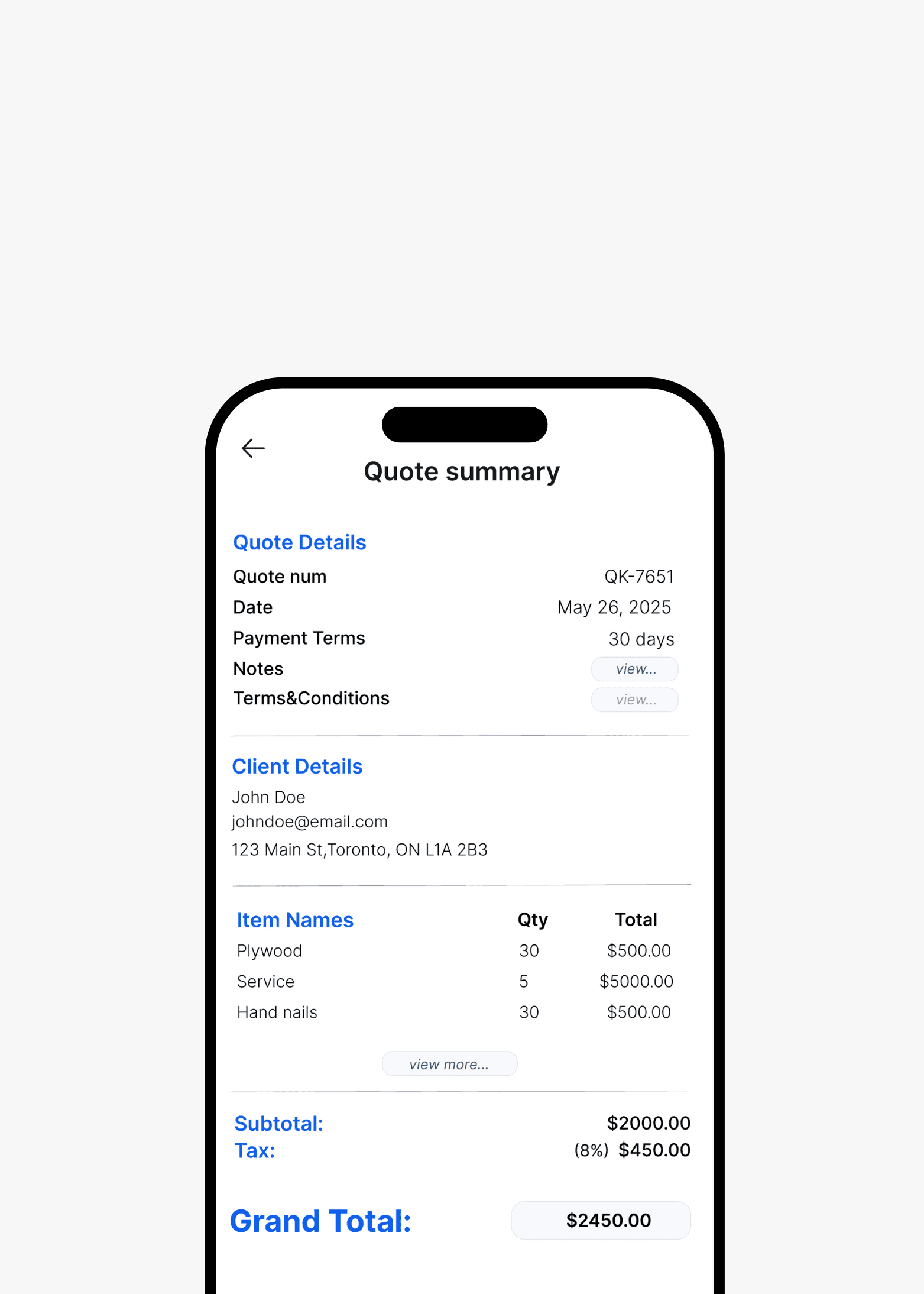
Clean Minimal Ui
Simple, clutter-free interface to reduce overwhelm
Create Quotes Quickly
Simple inputs to get quotes done quickly.
Manage multiple quotes
Save, organize and manage all quotes.
Automatic Calculations
Instantly calculates totals, taxes, and discounts.
PDF + Email ready
Simple export to share PDF quotes instantly.

Process
Initial Research
Initial Research
I started by using AI to gather quick data on the industry and potential user pain points. While this gave me a good starting point, I quickly realized I needed more. I began looking into existing tools to see what was missing and how I could make a simpler, more efficient version for contractors.
Designing & Development
I moved into Figma to build out all the UI screens, focusing on a clean and easy-to-use interface. I originally tried to build the app myself, but after many attempts, I kept running into technical issues with the no-code tool I was using. To move forward, I hired a developer specifically for Bubble.Io to build out the screens I designed into a functional web app.
Real Pricing
After Launch
I marketed the project on Reddit and Instagram, and I reached out to blue-collar creators for potential collaborations. However, the most important step was finally talking to real contractors. Through those conversations, I realized they strictly needed a mobile app rather than a web-based tool. This led to the conclusion that I couldn't move forward with the project as it was.
The Hustle
The summer after my first year, I was determined to build something of my own. I noticed the trades industry was overlooked by tech, with tools that were either too complex or outdated. I decided to build a quoting tool for contractors that focused on speed and clean design. Since I didn't know how to code, I had to be resourceful. I designed the entire UI in Figma and tried building it myself using Bubble.io and AI, eventually managing my budget to outsource the development when I hit a technical wall.
The Reality Check
My biggest mistake was falling in love with the idea before talking to real people. I relied too much on AI for research and ignored existing tools that didn't fit my vision, even pricing the service at $35 a month because it felt right. Once the web app was built, I marketed it on Instagram and Reddit and reached out to creators to collaborate, but nothing seemed to work. I couldn't understand why I wasn't getting any traction.
The Feedback
Everything changed when I finally got in contact with real contractors and blue-collar business owners. Their feedback was a major reality check. While they liked the clean design, they told me they strictly needed a mobile app for the job site, not a web-based tool. The price was also way too high, a mistake that came down to my lack of thorough market research. I realized too late that I should have validated my designs and pricing with actual users before paying for development. As a student founder with no more budget to pivot, I had already hit my ceiling.
The Hustle
The summer after my first year, I was determined to build something of my own. I noticed the trades industry was overlooked by tech, with tools that were either too complex or outdated. I decided to build a quoting tool for contractors that focused on speed and clean design. Since I didn't know how to code, I had to be resourceful. I designed the entire UI in Figma and tried building it myself using Bubble.io and AI, eventually managing my budget to outsource the development when I hit a technical wall.
The Reality Check
My biggest mistake was falling in love with the idea before talking to real people. I relied too much on AI for research and ignored existing tools that didn't fit my vision, even pricing the service at $35 a month because it "felt" right. Once the web app was built, I marketed it on Instagram and Reddit and reached out to creators to collaborate, but nothing seemed to work. I couldn't understand why I wasn't getting any traction.
The Feedback
Everything changed when I finally got in contact with real contractors and blue-collar business owners. Their feedback was a major reality check. While they liked the clean design, they told me they strictly needed a mobile app for the job site, not a web-based tool. The price was also way too high, a mistake that came down to my lack of thorough market research. I realized too late that I should have validated my designs and pricing with actual users before paying for development. As a student founder with no more budget to pivot, I had already hit my ceiling.
Lessons Learned
No platform Validation
No platform Validation
I learned that only good design doesn't guarantee a successful business. I spent my budget on a web app, only to find out through feedback that my users needed a mobile-first experience for the job site. From now on, I would use high-fidelity prototypes to test the platform and workflow with real people before any development begins.
Relying on AI for Research
I realized that relying solely on AI for research is a trap. It is too easy to find data that only fits the story you want to tell. From now on, I would use AI as a starting point but prioritize manual research, like face-to-face interviews and deep competitor analysis. I now understand that real-world validation is the only way to find the true information that AI cannot provide on its own.
Felt Pricing
I learned that pricing shouldn't be based on a feeling. It is a reflection of actual market value and competitor standards. I would now conduct thorough industry research and user testing much earlier to find a price point that makes sense and lowers the barrier to entry.
Process
Initial Research
I used AI to identify industry pain points and researched existing tools to find gaps. My goal was to strip away enterprise complexity and design a simpler, more efficient quoting version specifically for contractors.
Designing & Development
I designed all UI screens in Figma with a focus on ease of use. After hitting technical limits trying to build it myself, I hired a Bubble.io developer to transform my designs into a functional web app.
After Launch
I marketed on Reddit and Instagram, but real traction only came from direct conversations with contractors. I quickly learned they strictly required a mobile app for on-site use, leading to the difficult decision to halt the project.
Lessons Learned
No Platform Validation
Good design doesn't guarantee a successful business. I spent my budget on a web app, only to find out that users needed a mobile-first experience for the job site. In the future, I will use high-fidelity prototypes to test workflows with real people before any development begins.
Replying onAI for Research
Relying solely on AI for research can lead to confirmation bias. Moving forward, I will use AI only as a starting point and prioritize manual research, such as face-to-face interviews and deep competitor analysisto uncover real-world insights that AI cannot provide.
Felt Pricing
Pricing shouldn't be based on a feeling. It must reflect actual market value and competitor standards. I now understand the importance of conducting thorough industry research and user testing early on to find a price point that lowers the barrier to entry.
The Hustle
The summer after my first year, I was determined to build something of my own. I noticed the trades industry was overlooked by tech, with tools that were either too complex or outdated. I decided to build a quoting tool for contractors that focused on speed and clean design. Since I didn't know how to code, I had to be resourceful. I designed the entire UI in Figma and tried building it myself using Bubble.io and AI, eventually managing my budget to outsource the development when I hit a technical wall.
The Reality Check
My biggest mistake was falling in love with the idea before talking to real people. I relied too much on AI for research and ignored existing tools that didn't fit my vision, even pricing the service at $35 a month because it felt right. Once the web app was built, I marketed it on Instagram and Reddit and reached out to creators to collaborate, but nothing seemed to work. I couldn't understand why I wasn't getting any traction.
The Feedback
Everything changed when I finally got in contact with real contractors and blue-collar business owners. Their feedback was a major reality check. While they liked the clean design, they told me they strictly needed a mobile app for the job site, not a web-based tool. The price was also way too high, a mistake that came down to my lack of thorough market research. I realized too late that I should have validated my designs and pricing with actual users before paying for development. As a student founder with no more budget to pivot, I had already hit my ceiling.
komalbp2006@gmail.com